Good evidence, plausible dose
Saffron extract. Multiple randomised human trials, mostly for mood, at 28 to 30mg a day. Small enough to fit in a shared capsule, which makes it the one ingredient worth asking the seller about directly.

There is no published trial of the finished formula, so this page does the next best thing: grades every ingredient against the dose used in its own research, and checks whether one capsule could deliver it.
There is no published clinical trial of the finished Memo Volt formula. That is not unusual in this category, and it is the single most important fact on this page, because it means every confident claim you read about this product — positive or negative — is someone reasoning from ingredient research rather than reporting a result.
What can be done is assess each ingredient against the dose used in its own studies, and ask whether a single capsule could plausibly deliver that. That test is below.
Saffron extract. Multiple randomised human trials, mostly for mood, at 28 to 30mg a day. Small enough to fit in a shared capsule, which makes it the one ingredient worth asking the seller about directly.
Berberine has genuine human evidence for blood glucose and cholesterol at 900 to 1500mg a day. Morosil is studied at exactly 400mg. One capsule cannot hold either alongside eight other ingredients.
Corosolic acid at 10 to 48mg and oleuropein at 500 to 1000mg both have some human evidence — for blood sugar and blood pressure. Neither has cognitive evidence.
Fucoxanthin and fucoidan have essentially no human cognitive research. Kudzu flower uses the less-studied plant part. Ceylon cinnamon is studied at gram doses. Xylitol is a carrier.
A standard size 0 capsule holds roughly 400 to 500mg of powder. A larger size 00 holds around 700 to 800mg. That total has to cover all ten ingredients plus the flow agents and bulking material any capsule needs.
Berberine's research dose alone is 900 to 1500mg a day. Add Morosil at 400mg and saffron at 30mg and you are already past what one capsule can physically contain, with seven ingredients still to go.
The conclusion follows without needing the label: some ingredients here are necessarily present in small amounts. That is how nearly every multi-ingredient supplement is built. It just means the honest expectation is a small nudge rather than a research-level effect.
What would change this verdict. A published supplement facts panel with milligram amounts, a batch certificate of analysis from an independent lab, or a trial of the finished formula. Ask the seller for the first one before you order — how they answer tells you a lot.
No published clinical trial of the finished formula exists, so nobody can answer that with evidence. What can be assessed is each ingredient against its own research dose, and on that test one ingredient scores well, two have real evidence at doses a capsule cannot hold, and the rest have little or no human cognitive research.
The finished product has not, as far as any published record shows. Research that gets cited for products like this is always on individual ingredients, in their own studies, at their own doses.
Saffron extract, at roughly 28 to 30mg a day, and mostly for mood rather than memory. It is also one of the few ingredients here whose research dose could realistically fit alongside nine others in a single capsule.
No. The National Institute on Aging's position is that no dietary supplement has been shown to prevent, slow or reverse Alzheimer's disease or age-related cognitive decline. That applies to the whole category.
As a low-effort daily habit alongside sleep, exercise and medical care, with a 60-day guarantee making the trial low-risk, it is a reasonable thing to test. As an answer to a memory problem that already worries you, no — that needs a doctor.
General resources on dietary supplements and cognitive health from U.S. government health bodies. None of these organisations endorses, recommends or is connected to Memo Volt.
How to read these. Each source covers supplements as a category, or one ingredient at its own studied dose. None of it is evidence about a finished multi-ingredient product. No published clinical trial of the Memo Volt formula exists, and per-ingredient amounts are not disclosed on the label.
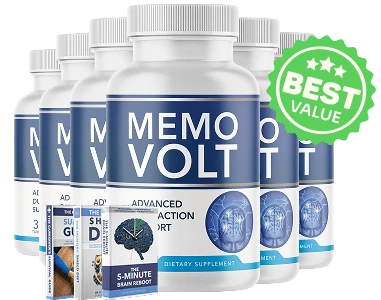
If you do try it, the 60-day guarantee is what keeps the decision low-risk. Confirm its terms on the checkout page before ordering.
View The Current Offer